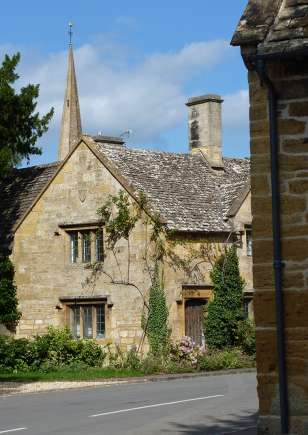
Stanton Village
Philip Stott, bought the Stanton Court Estate on 10th August 1906 at an auction in London. For the sum of £26,971 he acquired the mansion, Stanton Court itself, together with 882.5 acres of land. There were four farms (two of them let as a pair) and twenty-six cottages. Stott described his acquisition, perhaps with some exaggeration, as derelict. Certainly, it was in urgent need of attention. There followed a systematic programme of improvement work which eventually encompassed every building in the village. Almost immediately he built a reservoir to provide Stanton Court and the village with running water. Later he furnished the village with a Swimming Pool, extensions and heating to the School, a Parish Hall and electric street lights featuring lanterns on wrought iron brackets very much in the Arts and Crafts style and to Stott’s own design. Philip Stott moved permanently to Stanton Court in 1913 and continued to repair and improve the village to a state of almost unbelievable perfection until his death in 1937. Pevsner considered it architecturally perhaps the finest of the small North Cotswold villages.
One of England’s show villages, Stanton, Gloucestershire, is to be sold by auction. To its 300 inhabitants it i9s “England’s happiest village. The owner, Sir George Stott, architect, baronet is selling the eight farms, 33 cottages, a quarry, swimming pool, orchards, reservoir, village stores, post office and other property on the 1,300-acre estate. He and his family are leaving Stanton Court for a London urban villa. Sir George’s father fixed the cottage rents at 1s. 0½d a week. 10s. was the highest rent. Rates are 3d. a week. Sir George promised his father never to increase the rents, and he has kept his promise. Sir George gave this as the reason for selling the village of Stanton: “The village brings me £3,00 a year but outgoings come to £5,000 largely die to heavy taxation, so I have had to subsidise Stanton to the extent of £2,000 a year from my private means.” The villagers remember the Christmas gifts of tea for the women and tobacco for the men they used to receive from their squire. They recall his care of the sick and the parties he held for the children and few want to bid for their homes at the auction next month. [Liverpool Echo - Saturday 2 April 1949 page 3]
Reference Liverpool Echo - Saturday 2 April 1949 page 3